Smartphones are no longer just devices for making calls, sending messages, taking photos, and running apps. Increasingly, they can understand what users are doing and use that information to make everyday tasks easier.
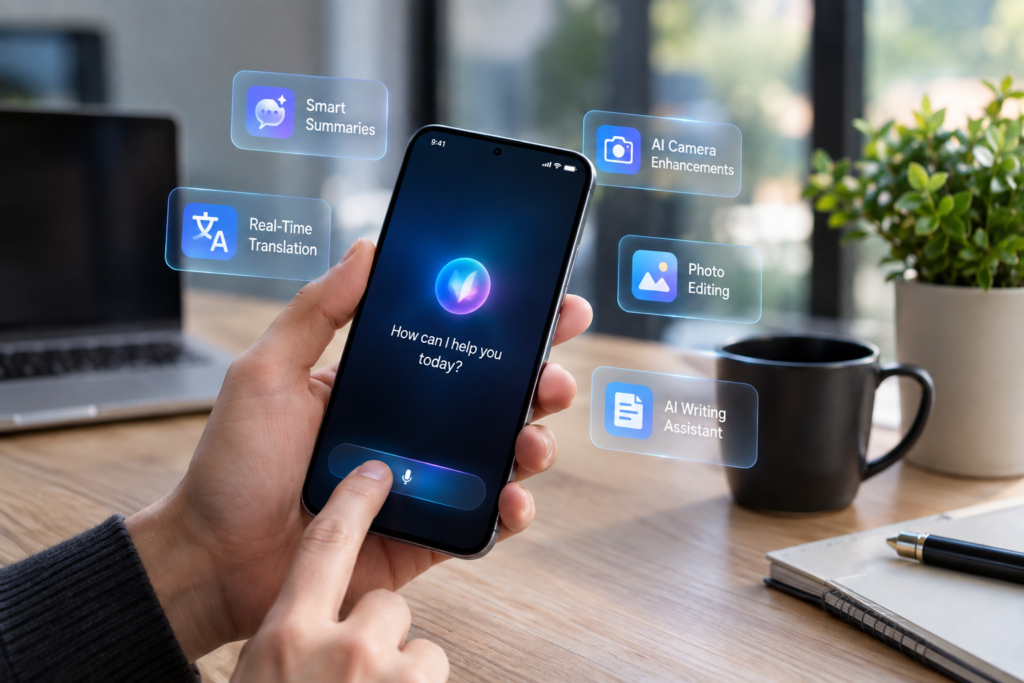
Smartphone AI is changing everything from photography and voice commands to writing, translation, search, battery management, and accessibility. Some features work through online services, while others can run directly on the phone using dedicated processing hardware.
The biggest change is not simply that phones have become more powerful. It is that they are becoming better at understanding information and responding to what users need.
AI Is Becoming Part of Everyday Smartphone Features
For many people, smartphone AI does not appear as one separate feature. Instead, it works quietly inside functions they already use.
When a phone improves a low-light photo, removes unwanted objects from an image, recognizes speech, filters spam calls, or suggests words while typing, software may be using machine-learning techniques behind the scenes.
This makes AI different from a traditional smartphone feature. Instead of following only fixed instructions, an AI-based system can process patterns in information and produce a result based on what it has analyzed.
The exact capabilities depend on the phone, operating system, manufacturer, and available services.
Smartphone Cameras Are Getting Smarter
Photography is one of the clearest areas where AI has changed smartphones.
A modern phone camera does much more than capture the light reaching its sensor. Software can analyze a scene and adjust processing to produce an image that looks clearer or more balanced.
Recognizing Scenes and Subjects
A phone can identify elements within an image, such as people, skies, food, plants, or other objects. This information can help the camera decide how to process different parts of a photograph.
AI-powered image processing can also help with difficult lighting conditions, portrait effects, noise reduction, and detail preservation.
The goal is not necessarily to replace the camera hardware. Instead, software helps the hardware produce a more useful final image.
Editing Photos With Less Effort
Newer smartphone software can also provide more advanced editing tools.
Depending on the device, users may be able to remove unwanted objects, improve certain areas of a picture, or make other changes with simple controls.
These features can save time compared with manually editing every part of a photograph.
However, AI-generated or heavily modified images can sometimes change details in ways that do not accurately represent the original scene. For important photographs, users should understand the difference between enhancement and content generation.
Voice Assistants Are Becoming More Useful
Voice control has existed on smartphones for years, but AI is helping phones understand natural language more effectively.
Instead of memorizing specific commands, users can increasingly communicate in a more conversational way.
A person might ask a phone to create a reminder, explain something, find information, or perform a supported action without using exactly the wording expected by older voice-command systems.
Speech recognition can also become more useful for people who have difficulty typing.
The quality of these features still depends on language support, internet connectivity, hardware, and the particular service being used.
AI Is Changing Smartphone Search
Traditional smartphone search usually depends on keywords.
For example, a user might type several words into a search box and then examine individual results.
AI-powered search can make the process more conversational. A user can describe what they are looking for in a complete question or provide information from an image or screen.
Some phones can also use information already visible on the display as part of a search or assistance feature, depending on the operating system.
This can make finding information more natural, particularly when the user does not know the exact name of something.
Writing and Messaging Are Becoming Easier
Smartphone keyboards have used predictive text and autocorrect for years. AI is taking these features further.
Depending on the device and software, users may receive help rewriting messages, correcting grammar, changing the tone of text, or creating a short summary.
This can be useful when writing emails, work messages, notes, or social media posts on a small screen.
However, generated text should still be reviewed before it is sent. Automated systems can misunderstand context or produce wording that does not accurately express what the user intended.
Translation Can Happen More Naturally
Language translation is another area where smartphone AI can be useful.
Modern phones can combine speech recognition, translation, and text-to-speech to help people communicate across languages.
A user may speak into a phone, have the speech converted into text, translate it into another language, and then hear or read the result.
Some translation features can also work with text found in images, such as signs or menus.
Offline capabilities vary between devices and languages, so users should not assume every translation feature will work without an internet connection.
AI Can Help Manage Smartphone Performance
AI is not limited to features that users directly interact with.
Smartphones can use software to manage resources such as battery power, processor activity, and background applications.
A phone can learn usage patterns and adjust certain processes to reduce unnecessary activity. The exact methods differ between operating systems and manufacturers.
This type of optimization is designed to make the device feel more responsive while using power efficiently.
It does not mean AI can eliminate battery limitations. Heavy gaming, high screen brightness, mobile data, cameras, and demanding applications can still consume significant power.
More AI Processing Is Moving Onto the Phone
One important development is the increasing ability of smartphones to process AI tasks locally.
Modern mobile processors can include specialized hardware designed to handle machine-learning workloads efficiently.
When a task runs on the device, information may not need to be sent to a remote server for every operation. This can reduce dependence on an internet connection and can sometimes improve response time.
However, local processing has limits. Large or demanding AI tasks may still require cloud computing, depending on the application and device.
On-Device AI vs Cloud AI
On-device AI processes information directly on the smartphone.
Cloud-based AI sends information to remote computing systems where the processing takes place.
Each approach has advantages and limitations. Local processing can help with responsiveness, offline functionality, and certain privacy considerations. Cloud processing can provide access to much larger computing resources.
Many modern smartphone features use a combination of both approaches.
AI Is Improving Accessibility
Smartphone AI can also make devices easier to use for people with different accessibility needs.
Speech recognition can help users control or interact with a phone without typing. Text recognition can make printed information easier to access. Image descriptions and other assistance features can provide additional context for visual information.
Live captions and speech-related tools can also help people understand spoken content in situations where listening is difficult.
These features are particularly useful because accessibility improvements can benefit many users, not only people who specifically turn on accessibility settings.
Smartphone AI Can Improve Security
AI-based systems can also assist with security.
Phones already use biometric technologies such as facial recognition and fingerprint authentication. Software can process biometric information to determine whether an authentication attempt matches the enrolled user.
AI-related techniques can also help identify suspicious activity, unwanted messages, spam calls, and potentially harmful behavior.
Security systems must be carefully designed because incorrectly identifying normal activity as suspicious can create problems, while failing to recognize genuinely harmful activity can create risks.
For this reason, AI is generally one part of a broader security system rather than a complete solution by itself.
Privacy Is an Important Part of Smartphone AI
As phones become better at analyzing personal information, privacy becomes increasingly important.
A smartphone may have access to photographs, messages, documents, location information, contacts, voice recordings, and other sensitive data depending on the permissions granted to applications and services.
Users should understand what information a feature requires and whether processing happens on the phone or through an online service.
Privacy controls can differ between operating systems and manufacturers, so checking application permissions and account settings is useful.
Convenience should not automatically mean giving every application access to every type of personal information.
AI Will Change How We Interact With Apps
Traditional smartphone use often involves opening an app and manually completing a series of steps.
AI could gradually reduce the number of steps required for some tasks.
Instead of thinking about which application to open, a user may increasingly describe the result they want and let the phone connect the appropriate tools or services.
For example, a person could ask for information from a document, request a summary, and then prepare the result for sharing.
This does not mean apps will disappear. More likely, the way users interact with them will continue to change.
The Limits of Smartphone AI
Despite its rapid development, smartphone AI is not perfect.
AI systems can misunderstand instructions, make incorrect assumptions, produce inaccurate information, or behave differently depending on the quality of the input.
Some features also require compatible hardware, supported languages, an internet connection, or a particular software version.
Users should therefore treat AI as a tool rather than assuming every result is automatically correct.
This is especially important when dealing with financial information, medical questions, important documents, or other situations where an incorrect answer could have serious consequences.
What Smartphone AI Could Mean for Future Phones
As smartphone processors become more capable, AI is likely to become less noticeable as a separate feature.
Instead of opening an application specifically because it has an AI function, users may simply interact with the phone normally while AI works in the background.
Cameras may automatically understand more of a scene. Voice interaction could become more natural. Search may become more conversational. Translation could become easier, and phones may become better at adapting to individual usage patterns.
The exact direction remains uncertain because future features will depend on hardware, software development, privacy policies, and how people choose to use these technologies.
Conclusion
Smartphone AI is changing the way people use phones by making many everyday functions more capable and less dependent on manual steps.
From photography and translation to writing, search, accessibility, security, and device optimization, AI is increasingly becoming part of the smartphone experience.
The most significant change may be the shift from phones simply following commands to phones understanding more about what the user is trying to accomplish.
For MobileVerseTopic readers, the important thing to watch is not just how many AI features a phone advertises, but how useful those features are in real-world situations. A good smartphone experience will depend on a combination of capable hardware, reliable software, useful AI tools, and sensible privacy controls.