Introduction
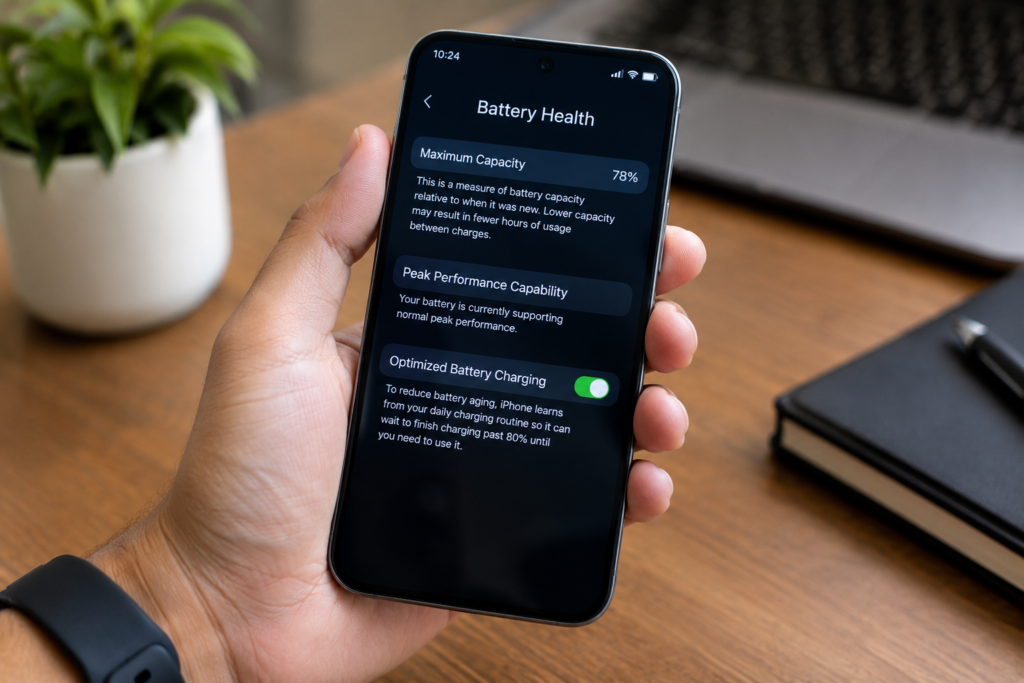
Few things are more frustrating than realizing your smartphone no longer lasts as long as it used to. When the device was new, it could comfortably get through a day of use. Months or years later, the battery may drain faster, require more frequent charging, or even cause unexpected shutdowns.
This leads many users to check their battery health and wonder why the number keeps decreasing over time.
The truth is that battery health decline is a normal part of owning a smartphone. Every modern phone battery ages gradually, regardless of brand, operating system, or price. However, some habits and environmental factors can accelerate the process.
Understanding why phone battery health drops over time can help you take better care of your device, avoid common mistakes, and extend battery lifespan as much as possible.
What Does Battery Health Actually Mean?
Before discussing why battery health declines, it helps to understand what the term means.
Battery health is generally an estimate of how much of the battery’s original capacity remains compared to when it was new.
For example, when a battery is brand new, it can store its full designed amount of energy. As it ages, its maximum capacity gradually decreases.
This means:
- The battery stores less energy
- Charging may become more frequent
- Battery life becomes shorter
- Performance management may become more noticeable
Battery health does not usually indicate whether a battery is safe. Instead, it reflects aging and capacity loss over time.
All Lithium-Ion Batteries Age Naturally
The most important thing to understand is that smartphone batteries are consumable components.
Nearly all modern smartphones use lithium-ion battery technology.
These batteries are designed to be rechargeable, but they are not designed to last forever.
Chemical Aging Is Unavoidable
Every time a battery charges and discharges, chemical reactions occur inside it.
Over time, these reactions gradually reduce the battery’s ability to store energy.
This process happens naturally regardless of how carefully the device is used.
Even a phone that spends most of its life sitting unused will experience some degree of battery aging.
Battery health decline is therefore normal and expected.
Charge Cycles Contribute to Battery Wear
One of the biggest factors affecting battery health is charge cycles.
A charge cycle refers to the cumulative use of energy equivalent to a full battery discharge and recharge.
For example:
- Using 50% today and charging
- Using another 50% tomorrow and charging
may collectively count as one full cycle.
More Cycles Mean More Aging
The more cycles a battery experiences, the more its internal components gradually wear down.
This is similar to how mechanical parts eventually wear with use.
People who heavily use their phones throughout the day often accumulate charge cycles faster than light users.
As a result, battery health may decline more quickly.
Heat Is One of the Biggest Enemies of Battery Health
If there is one factor that consistently accelerates battery degradation, it is heat.
High temperatures can speed up the chemical aging process inside lithium-ion batteries.
Why Heat Causes Damage
When a battery becomes hot, internal chemical reactions become more aggressive.
Over time, excessive heat can:
- Reduce battery capacity
- Increase battery wear
- Shorten overall lifespan
- Cause faster battery health decline
This is why manufacturers place significant emphasis on temperature management.
Heat affects batteries far more than many users realize.
Gaming Can Increase Battery Wear
Gaming places heavy demands on a smartphone.
During gaming sessions:
- The processor works harder
- The graphics chip remains active
- The display consumes more power
- The battery delivers more energy
All of these activities generate heat.
Long Gaming Sessions Create Stress
Occasional gaming is not a problem.
However, prolonged gaming sessions—especially on demanding titles—can raise internal temperatures significantly.
If gaming regularly causes the phone to become very hot, battery aging may occur faster compared to lighter usage patterns.
This does not mean gaming is harmful by itself. The real concern is the heat generated during extended sessions.
Charging While the Phone Is Hot
Many people plug in their phone while it is already warm from gaming, video recording, or intensive usage.
This can increase battery stress.
Heat Plus Charging
Charging naturally generates some heat.
If the device is already warm before charging begins, temperatures may rise even further.
Examples include:
- Gaming while charging
- Charging in direct sunlight
- Charging immediately after intensive tasks
Repeated exposure to these conditions can contribute to faster battery aging.
Allowing the device to cool slightly before charging may help reduce unnecessary stress.
Fast Charging and Battery Health
Fast charging has become a major feature in modern smartphones.
It allows batteries to recharge much more quickly than older charging systems.
Does Fast Charging Damage Batteries?
Modern fast charging systems include safeguards designed to manage heat and protect battery health.
Under normal conditions, manufacturer-approved fast charging is generally considered safe.
However, higher charging speeds can generate more heat compared to slower charging methods.
Since heat contributes to battery aging, temperature management remains important.
The quality of the charging system matters more than charging speed alone.
Keeping the Battery at 100% for Long Periods
Many users leave their phones plugged in overnight every night.
Modern smartphones are designed to manage charging intelligently, but long periods at full charge can still contribute to gradual battery aging.
High Charge Levels Create Stress
Lithium-ion batteries experience greater stress when maintained at extremely high charge levels for extended periods.
This is one reason many manufacturers have introduced battery protection features.
These features may:
- Delay charging completion
- Limit maximum charge levels
- Learn user charging habits
Such tools are designed to reduce unnecessary battery wear over time.
Frequently Draining the Battery to Extremely Low Levels
Older battery technologies sometimes benefited from full discharges.
Modern lithium-ion batteries work differently.
Deep Discharges Add Stress
Allowing a battery to reach extremely low levels repeatedly may contribute to additional wear.
Most experts generally recommend avoiding frequent complete discharges when possible.
Instead, moderate charging habits tend to place less stress on the battery.
Occasional deep discharges are not usually a problem, but making them a daily habit may accelerate aging.
Background Apps Can Increase Battery Wear Indirectly
Battery health is not only affected by charging habits.
The way a phone is used also matters.
Constant Background Activity
Some apps continue running even when users are not actively using them.
Examples include:
- Location tracking
- Cloud synchronization
- Social media updates
- Streaming services
Excessive background activity can:
- Increase battery consumption
- Require more frequent charging
- Increase charge cycle accumulation
Over time, this indirectly contributes to battery aging.
Environmental Conditions Matter
The environment around your phone affects battery health more than many users realize.
Hot Weather
Leaving a smartphone in a hot car is one of the worst things for battery health.
Vehicles can become extremely hot, even on moderately warm days.
Excessive heat exposure may accelerate battery degradation significantly.
Cold Weather
Cold temperatures affect battery performance differently.
A battery may temporarily appear weaker in cold environments, but this does not necessarily mean permanent damage has occurred.
Once the battery returns to a normal temperature range, performance often improves.
Long-term heat exposure is generally a greater concern than occasional cold weather.
Software Updates and Battery Health
Some users believe software updates directly damage battery health.
In most cases, battery health decline is primarily caused by normal aging rather than software updates.
Why Battery Life Sometimes Changes After Updates
A software update may temporarily affect battery usage because:
- Apps are re-indexing
- Background tasks increase briefly
- New features consume additional power
This affects battery life rather than battery health itself.
Battery health reflects the battery’s physical condition, not simply how quickly power is consumed.
Using Poor-Quality Chargers and Accessories
Charging accessories play an important role in battery safety and reliability.
Not All Chargers Are Equal
Low-quality chargers may:
- Deliver unstable power
- Generate excessive heat
- Provide inconsistent charging behavior
While not every third-party charger is problematic, using reputable accessories that meet appropriate standards is generally the safer option.
A stable charging environment helps support long-term battery performance.
Signs That Battery Health Has Declined
As battery health decreases, users may notice several changes.
Common signs include:
- Faster battery drain
- More frequent charging
- Reduced screen-on time
- Unexpected shutdowns
- Slower performance in some situations
These symptoms usually become more noticeable as battery capacity decreases further.
Battery aging tends to occur gradually rather than suddenly.
How to Slow Battery Health Decline
Battery aging cannot be completely prevented, but it can often be slowed.
Helpful habits include:
- Avoid excessive heat
- Use quality chargers
- Limit gaming while charging
- Avoid leaving phones in hot vehicles
- Keep software updated
- Reduce unnecessary background activity
- Use built-in battery protection features when available
These practices support healthier battery conditions over the long term.
Why Battery Health Will Never Stay at 100%
Many users become concerned when battery health drops from its original value.
In reality, no lithium-ion battery remains at maximum capacity forever.
Even careful users will eventually see battery health decline.
The goal is not to prevent aging entirely but to slow it enough that the battery remains useful for as long as possible.
A small reduction in battery health after extended use is often completely normal.
Conclusion
Phone battery health drops over time because lithium-ion batteries naturally age through chemical wear, charge cycles, and everyday usage. Factors such as heat, heavy gaming, charging habits, environmental conditions, and frequent charging cycles can accelerate this process, while careful usage can help slow it down.
The most important thing to remember is that battery aging is expected, not a defect. Every smartphone battery gradually loses capacity as it gets older. By understanding what affects battery health and adopting better charging and usage habits, users can extend battery lifespan and maintain better performance for longer. For readers of MobileVerseTopic, knowing how batteries age is one of the simplest ways to get more value from a smartphone over the years.